The bedroom is the room a household upgrades last and needs first. It earns no guests, wins no compliments, and quietly absorbs every object the rest of the home refuses: the laundry between states, the boxes without an address, the chair that became a shelf. Then one morning the floor has disappeared, the door only half opens, and the room where a third of your life happens has become the hardest room in the house to live in.
The repair has a correct order, and it is not the intuitive one: storage first, then the bed, then sleep itself, then the dressing corner, and finally the one safety step that too many bedrooms skip. We come at the problem from the furniture side, because that is the side we build, and every piece named here comes from OLIXIS home gear with the price from our last update beside it.
Why storage goes first
The instinct is to start with the bed, because the bed is the room's monument. The instinct is wrong. A new bed in a cluttered room is a monument in a storage unit. A storage fix in an old room is a renovation.
Start with a blunt audit. Empty the floor, the chair and the top of every surface onto the bed, and sort the pile into three answers: hangs, folds, or leaves. The hanging pile goes to the closet or a garment rack. The folding pile is the one that decides your furniture, because folded clothing is measured in drawers, and drawers are the unit the bedroom actually runs on.
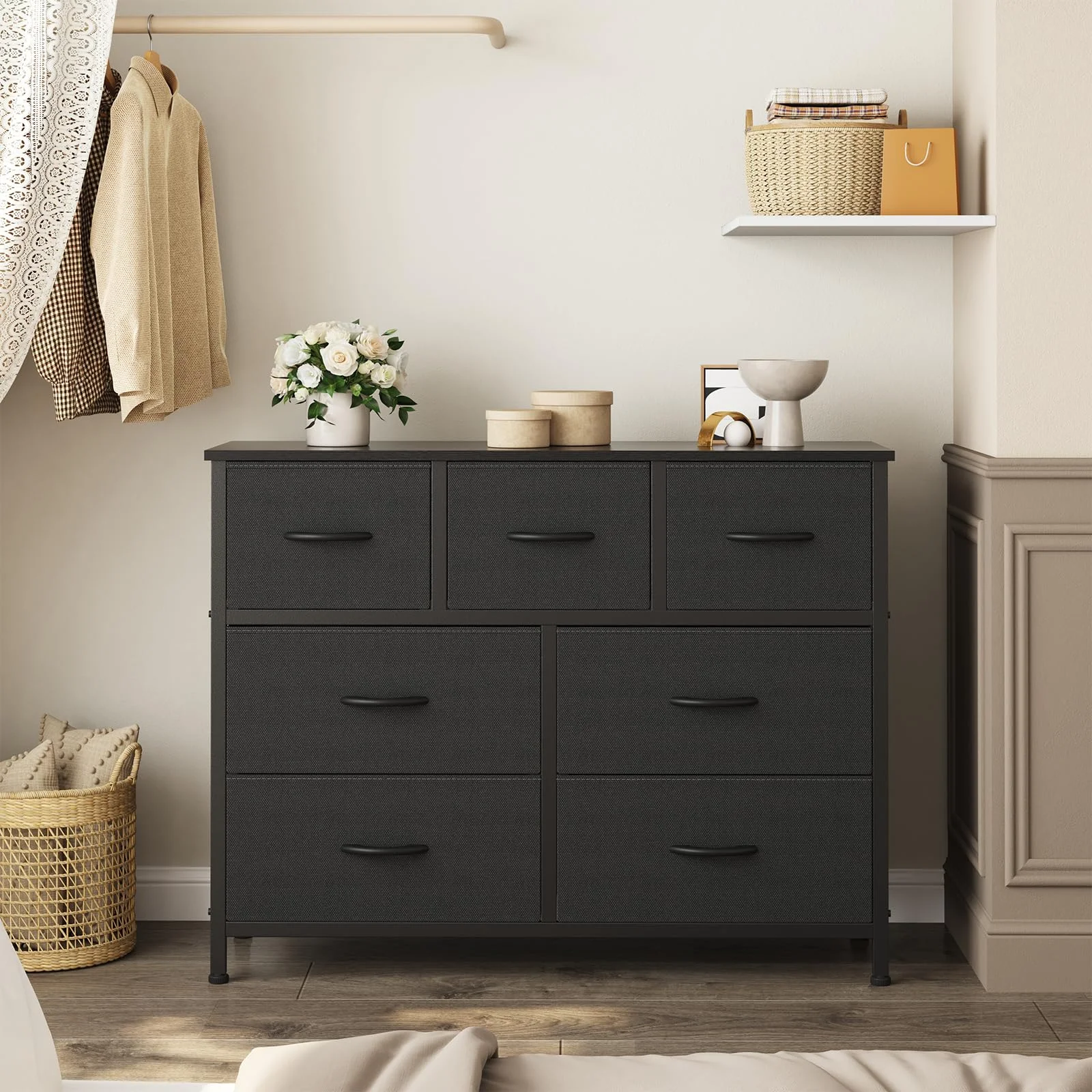
Count honestly. A person's everyday rotation, socks and underwear included, fills four to five drawers. Two people sharing a room fill eight to ten. Add a drawer per person for the off-season layer, and the arithmetic lands almost every couple in the same range: nine to twelve drawers, which is exactly why our most-carried dresser sizes are seven and nine.
A bedroom is not short on space. It is short on drawers, and the difference between the two is one evening of assembly.
The fabric-drawer format is our answer to the bedroom's specific physics. A steel frame carries the load, so the piece weighs a fraction of a hardwood chest and moves when the room changes. The drawers themselves are structured fabric on rails: light enough to lift out and carry to the laundry, deep enough that a folded stack fits standing up, which is the storage trick that doubles what a drawer holds. Our seven-drawer unit in black runs $39.90 in the current update, and the nine-drawer tall version, the one for rooms that must grow upward instead of outward, is $49.91.
For a child's room, the same logic applies at a smaller height. The five-drawer wide format at $32.74 keeps every drawer within a short reach, and the wide top becomes the staging surface that children's rooms burn through daily.
The bed frame decision
With the floor recovered, the bed is worth looking at honestly, and the honest question is not comfort. It is air.
The space under a mattress is the largest unclaimed storage volume in almost every bedroom. A frame that holds the mattress fourteen inches off the floor turns that dead air into a luggage garage, a season closet, and a home for everything the drawers should not waste their space on. Our metal queen frame with a fourteen-inch clearance is $44.97 in the current update, needs no box spring, and assembles in the evening the manual promises.
The steel platform format has a second, quieter virtue: it does not creak. Creak is the sound of joints moving, and a bolted steel frame with the mattress sitting on a full slat deck has very few joints to move. If your current bed announces every turn, the frame, not the mattress, is usually the culprit.
Two upgrades from the plain platform earn their price in specific rooms. A frame with a headboard, like our full-size foundation rated to 800 pounds at $84.60, gives the bed a finished wall and a backrest for the reading hour. And the full platform with built-in underbed storage at $89.99 formalizes the space under the deck into real compartments, which is the difference between storage and a place where things are lost horizontally.
Whichever format you choose, measure the room before the frame, not after. A queen frame wants a room where at least two feet of walking lane survives on the entry side. If the lane dies, drop to a full. A smaller bed you can walk past beats a larger bed you climb over, every night, twice.
Sleep: the topper before the mattress
Here is the money conversation nobody has in the right order. A tired mattress sends people shopping for a new mattress, which costs what a whole room of furniture costs. The intermediate step, the one worth trying first, is a topper: three inches of new pressure surface on top of the old structure.
A topper is the right call when the mattress is structurally sound but surface-tired: firm spots, a warm sleep, the feeling of lying on the mattress rather than in it. It is the wrong call when the mattress has a valley. Foam follows the surface under it, and three new inches obey a sag as faithfully as the old surface did.
Our gel-infused memory foam topper, three inches in twin, is $31.91 in the current update. The gel is not decoration: memory foam cradles by contact, and contact holds heat, so the infusion exists to pull that heat away from the sleeper. The foam itself is CertiPUR-US certified, made without regulated formaldehyde, heavy metals or phthalates and low-emission for indoor air, and the certification program is public, linked in the sources below rather than taken on our word.
For sleepers who run warm even on gel, the bamboo-viscose format at $28.56 for a full takes the other road: less cradle, more airflow, a cover that feels cool at first touch and washes like bedding, because it is bedding.
One practical note that saves an evening: a rolled topper wants a few hours flat before the first night. Unbox it in the morning, let it breathe and flatten on the bed through the day, and sleep arrives on schedule.
The dressing corner
A bedroom that stores well and sleeps well is still missing its third function: it is where a person gets ready. The dressing corner is the cheapest of the three upgrades and the one felt most often, twice a day, every day.
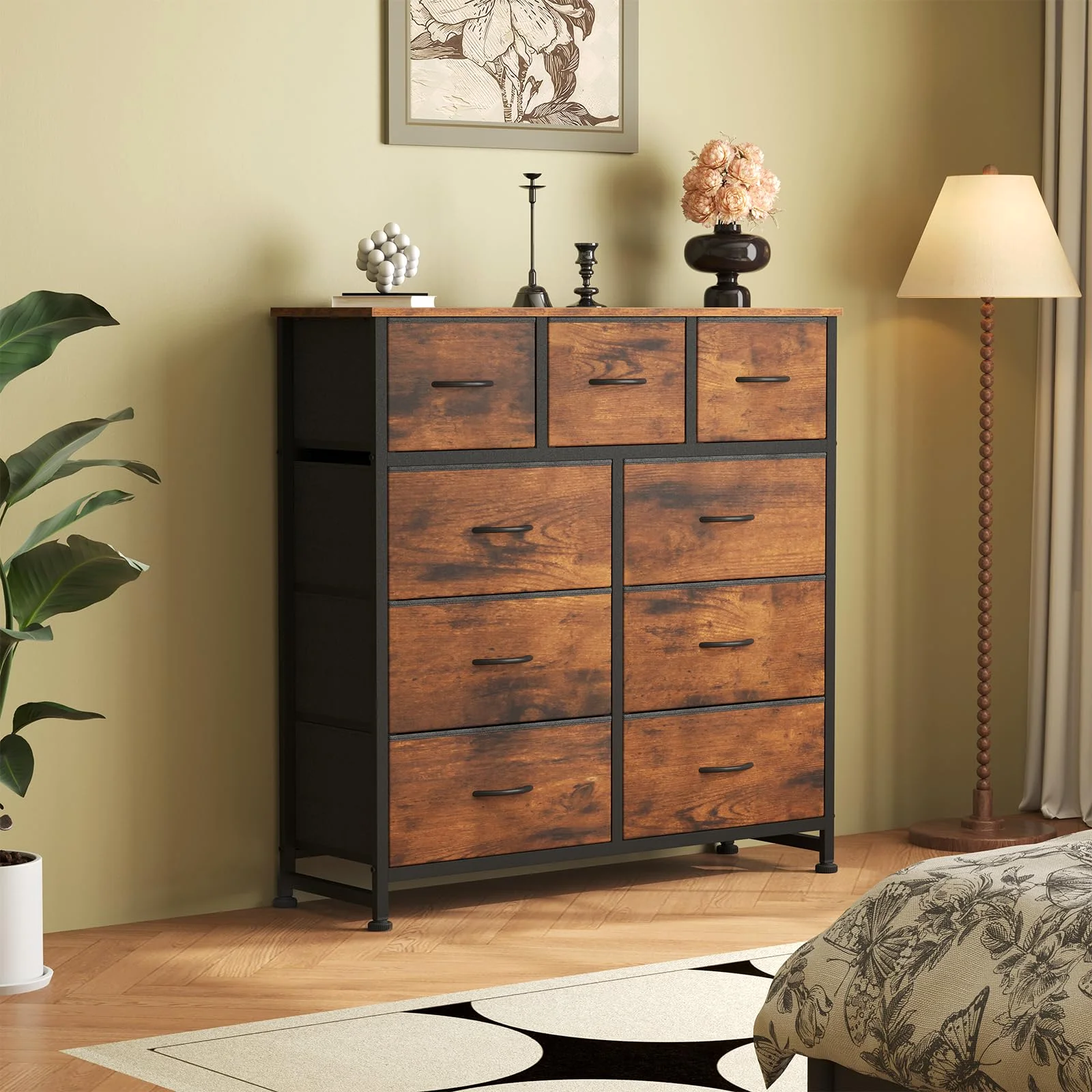
The anchor of the corner is a mirror with real length. Our arched floor mirror stands 64 inches tall at $47.92, leans or stands on its own support, and does the one job a closet-door mirror does badly: shows the whole person, shoes included, in one look. The arch is not just fashion. A tall rounded shape reads as furniture rather than as glass, and lets a small room carry a large mirror without feeling clinical.
Beside the mirror, the nightstand earns its keep with an outlet. Ours is $24.97 in the current update with a charging station built into the back edge: the phone lands there at night, the cable disappears, and the top surface stays a surface instead of a charging depot.
The far end of this corner's budget is the piece we consider the dressing room's endgame: a swivel jewelry cabinet with a built-in light and a lockable full-length mirror door, $159.99 in the current update. It is a mirror, a jewelry wall and a small safe in one square foot of floor, and for households where the collection has outgrown a drawer tray, it replaces a dresser's worth of small-object chaos.
Three floor plans, three storage answers
The advice above assumes an average room, and no one lives in an average room. Here is how the same plan bends to the three bedroom shapes we hear about most.
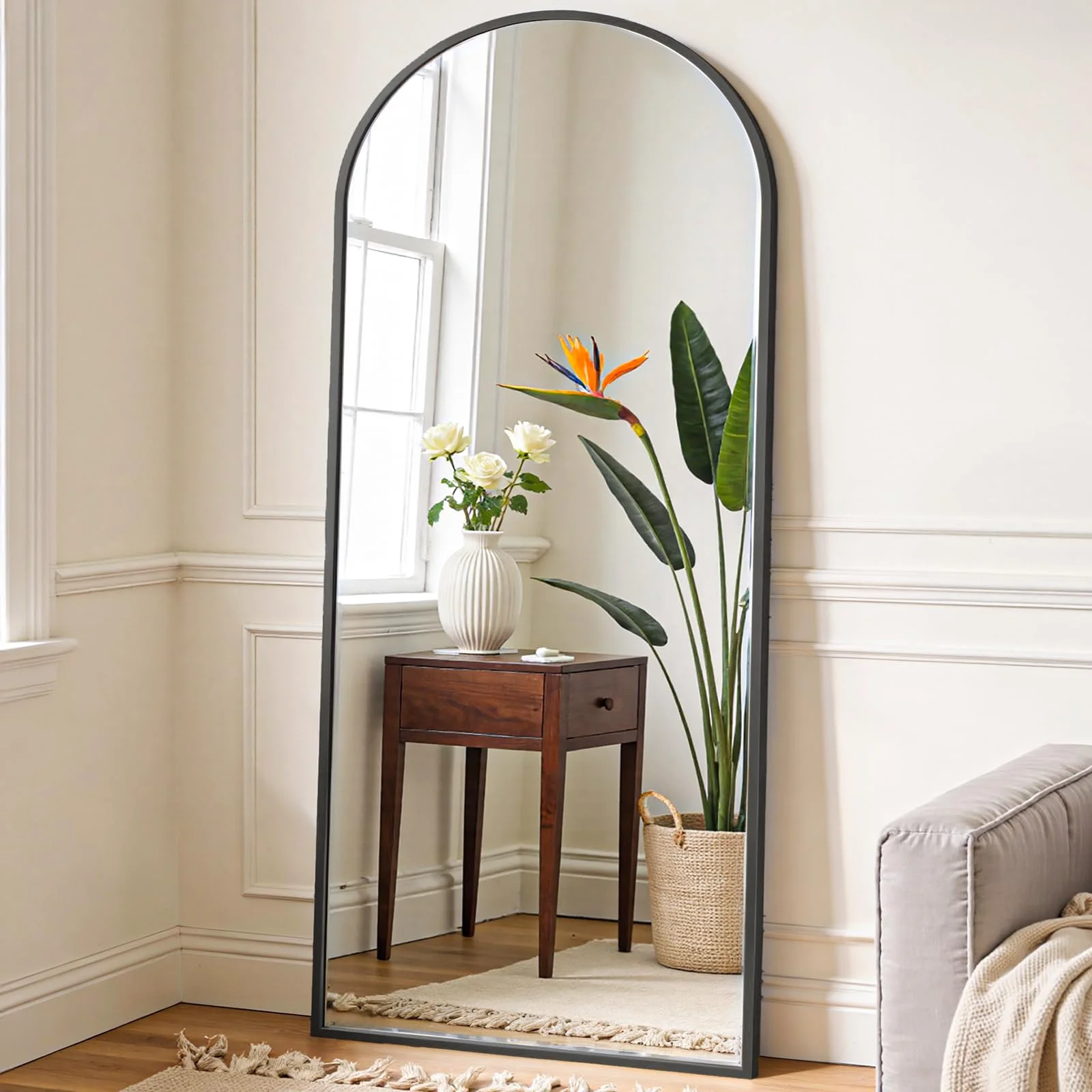
The long narrow room, the one shaped like a hallway with ambitions, punishes anything wide and rewards anything tall. This is the floor plan the nine-drawer tall dresser was built for: it takes one stride of wall and grows toward the ceiling instead of into the walking lane. Put the bed's long side against the long wall, stand the tall dresser in the dead corner past the door swing, and let the mirror live on the opposite wall, where it visually doubles the room's short dimension, which is the dimension that needs the help.
The square small room, common in older buildings, has the opposite problem: every wall is short, so nothing wide fits anywhere. Here the bed frame does the heavy lifting. Choose the fourteen-inch clearance and treat the underbed volume as the room's true closet: flat bins for the off-season layer, luggage nested inside luggage, the spare bedding in the bag it came in. Above the floor, one seven-drawer unit usually suffices once the underbed layer absorbs everything bulky, and the corner that remains takes the mirror at an angle, which softens the boxiness square rooms suffer from.
The shared room, whether a couple's or two children's, is an arithmetic problem before it is a furniture problem. Two people means two piles at the audit, and the piles are never equal. Buy for the larger pile plus a margin, not for the average. A couple typically lands on one tall unit and one wide unit rather than two matching pieces, because wardrobes split by height, not by symmetry: one person's rotation hangs, the other's folds. For children sharing a room, two five-drawer wide units beat one large shared piece for a reason every parent already knows: shared drawers have no owner, and drawers with no owner belong to the floor.
In all three rooms the walking lane is the non-negotiable. Furniture that costs the lane costs the room, and no storage gain repays climbing sideways past a drawer unit every morning. When a piece and the lane cannot coexist, the piece is wrong, not the room.
The safety step: anchor the tall pieces
Every tall piece named above ships with a wall-anchor kit in the box, and the kit must not stay in the box. Here is why.
Furniture tip-overs are a specific, documented hazard, and the households most at risk are the ones with climbers in them: a dresser's drawers, opened in ascending order, are a staircase to a child. The U.S. Consumer Product Safety Commission has run its Anchor It! campaign for over a decade on exactly this point, and its message fits in one line: anchor all furniture with drawers, doors and shelves to the wall. Since 1 September 2023, clothing storage furniture sold in the United States also falls under a federal stability rule, which is the regulatory floor under the whole habit.
The installation is honestly minor. A stud finder, a drill, a screwdriver, and the strap in the box: one bracket to the wall stud, one to the piece, connect, tighten, tug to test. Fifteen minutes, once, per piece. Our dressers come with the anchor points pre-drilled, so the fifteen minutes does not begin with measuring.
Renters anchor too. The two screw holes a kit leaves in a wall are the same class of repair as a picture hook, filled in minutes when you move out, and no deposit is worth the alternative math.
The order of purchases, priced
Rooms are furnished in chapters, and this room's chapters have a natural order. Here is the whole plan as a single budget, using current-update prices, with each chapter standing on its own if the budget pauses there.
| Chapter | The piece | Price | What changes |
|---|---|---|---|
| 1. Storage | 7-Drawer Fabric Dresser | $39.90 | The floor comes back |
| 2. The bed | Metal Queen Bed Frame, 14-Inch | $44.97 | Underbed air becomes a closet |
| 3. Sleep | 3-Inch Gel Foam Topper, Twin | $31.91 | The old mattress retires later |
| 4. The corner | Arched Full-Length Mirror | $47.92 | Mornings stop happening in fragments |
| 5. The outlet | Nightstand with Charging Station | $24.97 | The cable disappears |
| 6. The endgame | Swivel Jewelry Cabinet | $159.99 | A dressing room in one square foot |
Chapters one through five, the whole working bedroom, come in under $190 at the current update, which has been the argument from the first paragraph: the bedroom is not an expensive room to fix. It is an unplanned one.
Prices move between updates, and where a figure here disagrees with a checkout, the checkout is right. The schedule itself lives on our update page.
What we deliberately left out
A repair plan is defined by what it refuses, so here is what did not make this one.
A new mattress did not, for the reason the topper section gave: it is the most expensive object in the room and the last one worth replacing, tried only after the cheaper surface fix has had its month. A wardrobe did not, because wardrobes solve hanging storage, and most bedrooms drown in folding storage. Audit first, and let the pile decide. Matching sets did not, because sets bill you for symmetry, and a bedroom needs function in a sequence, not furniture in a costume.
And decoration did not, though not because it does not matter. It matters last. A room that stores, sleeps and dresses well is already most of the way to looking right, because visible floor and clear surfaces are what a calm room is mostly made of.
The one-evening rule, applied
Everything in this plan assembles the way our whole catalog assembles: one adult, one evening, tools in the box. For this room specifically, the order inside the evening matters, so here is the working sequence we would use ourselves.
- Assemble the dresser first, and fill it from the bed pile immediately. Storage that starts full never becomes a second chair.
- Do the bed frame next, while the floor is still clear, because a frame wants swing room during assembly.
- Unroll the topper in the morning, not at night, and give it the day to flatten.
- Stand the mirror where the window light crosses it sideways. A mirror facing a window head-on becomes a lamp.
- Anchor the tall pieces the same evening their boxes are emptied. The kit left in a drawer is the kit that never goes in.
A bedroom rebuilt in this order is done in a weekend without feeling like a project, which is the quiet standard everything we build aims at. The room where a third of your life happens deserves the same planning as the rooms that host guests, and it costs less to give it that plan than most households spend apologizing for its absence. For the office corner that often shares this same floor plan, the next guide, the home office corner, continues where this one stops, and the whole house, room by room, is on the front page of the catalog.
