- The corner audit: where the office goes
- The desk: buy the surface, not the furniture
- The chair: the eight-hour decision
- The paper problem
- The wall: memory you can walk past
- Movement: the office that does not hold still
- The corner on camera
- Two workers, one corner
- The corner, priced as a project
- Keeping the border
Somewhere in the last few years, the kitchen table lost a war it never agreed to fight. It became a desk from nine to five and a dinner table at seven, and it does both jobs the way any conscripted soldier does: resentfully, and not very well. The laptop lives beside the fruit bowl. The back aches by Thursday. The work never quite leaves the room, because the room was never given a place for the work to live.
The discharge takes five decisions, made in a home that does not have a spare room: the desk, the chair, the paper problem, the wall, and the movement that keeps an office body functional. Every piece named comes from the OLIXIS house plan, with the price from our last update, and the health claims come from public agencies we link at the end, not from furniture marketing.
The corner audit: where the office goes
An office corner needs less than people fear: about five feet of wall, an outlet within cord's reach, and a defensible border. The border is the part that matters. Work that happens everywhere follows you everywhere. Work that happens in one corner can be left in that corner, which is the entire psychological technology of an office, reduced to geometry.
Walk the home with those three requirements and candidates appear in rooms that seemed full: the bedroom wall past the dresser, the living room's dead corner behind the couch arm, the wide spot in a hallway that never earned furniture, the corner of a dining room that dinner never reaches. Corners beat walls, which is worth knowing before the desk decision, because a corner-shaped desk turns the least usable spot in a room into the most productive one.
Light decides between finalists. A desk that faces a window head-on trades a view for a day of squinting past it. A desk with the window beside it gets the light without the glare. If every candidate corner is dark, that is a lamp problem, not a disqualification.
The desk: buy the surface, not the furniture
Desk marketing sells drama: battlestations, command centers, executive suites. The working truth is simpler. A desk is a surface at the right height with the right footprint, and the footprint question comes first.
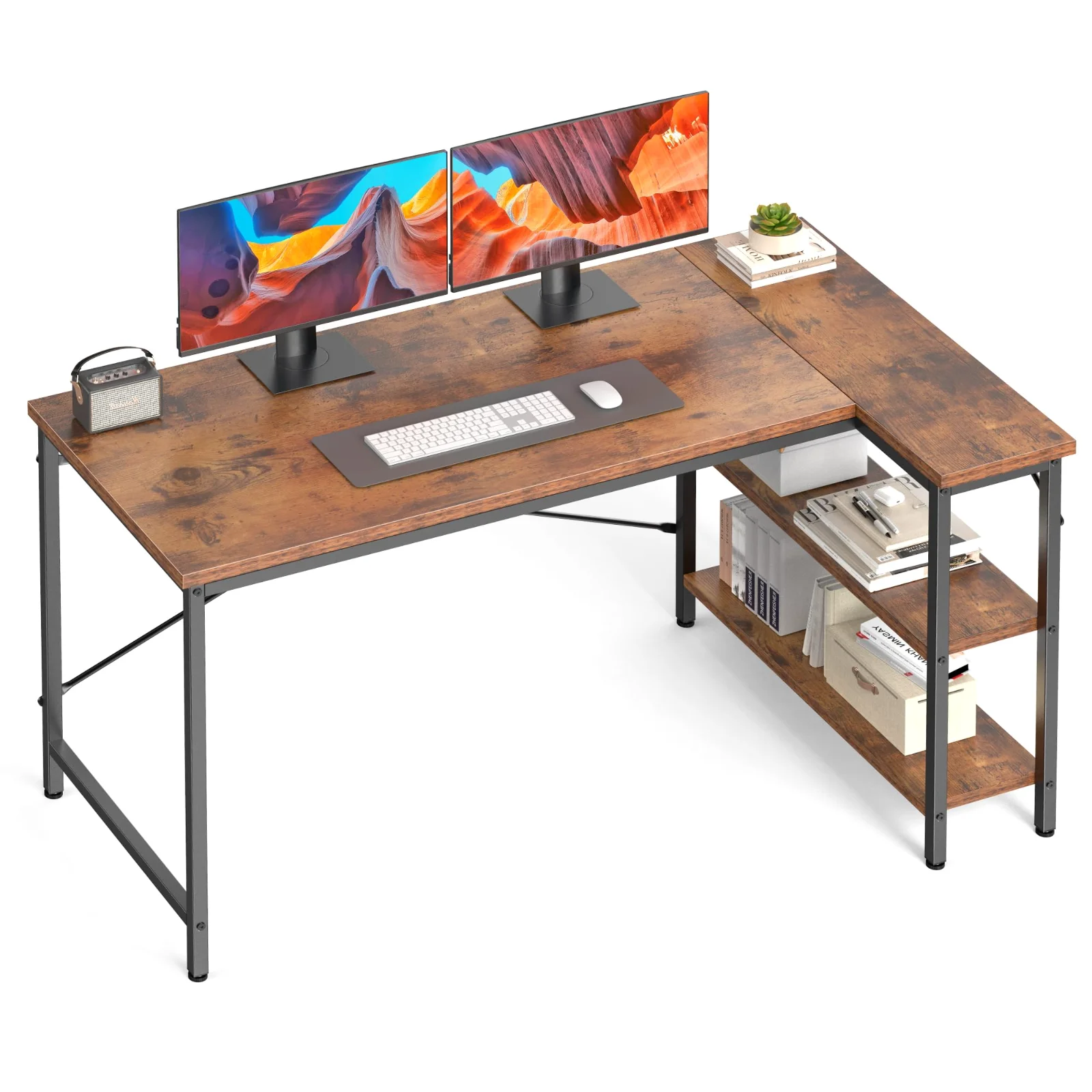
For the corner spots the audit usually finds, the L-shaped format is the quiet winner. Our 47-inch L-shaped corner desk, $41.99 in the current update, folds two work zones into a corner that a straight desk would waste: screen and keyboard on one wing, the paper-and-coffee zone on the other. The L is also the honest answer for two-monitor setups, which straight desks under fifty inches handle badly.
For a wall spot with more width, the storage-integrated format earns its space twice. The 55-inch desk with six fabric drawers, $69.97 in the current update, is a desk and a dresser fused at the hip: the drawers swallow the cables, chargers, notebooks and printer paper that otherwise colonize the surface. A desk with storage under it means the office corner needs one piece of furniture, not two, which in a borrowed corner is the whole game.
The desk is not where work happens. It is where work is allowed to stay, and that permission is what the kitchen table could never grant.
Whichever format fits, resist the instinct to buy bigger than the corner. A desk that crowds its walking lane gets resented, and resented furniture migrates to storage. The corner audit gave you a number of inches. Believe it.
The chair: the eight-hour decision
The chair is where the budget should bend, because the chair is the only piece of office furniture your body wears. The federal ergonomics guidance, OSHA's computer workstation checklist, does not name brands or prices. It names positions. Lower back supported. Shoulders relaxed. Elbows close to the body and supported. Feet flat on the floor. A chair either lets an ordinary body hit those positions or it does not, and the difference is adjustability, not upholstery.
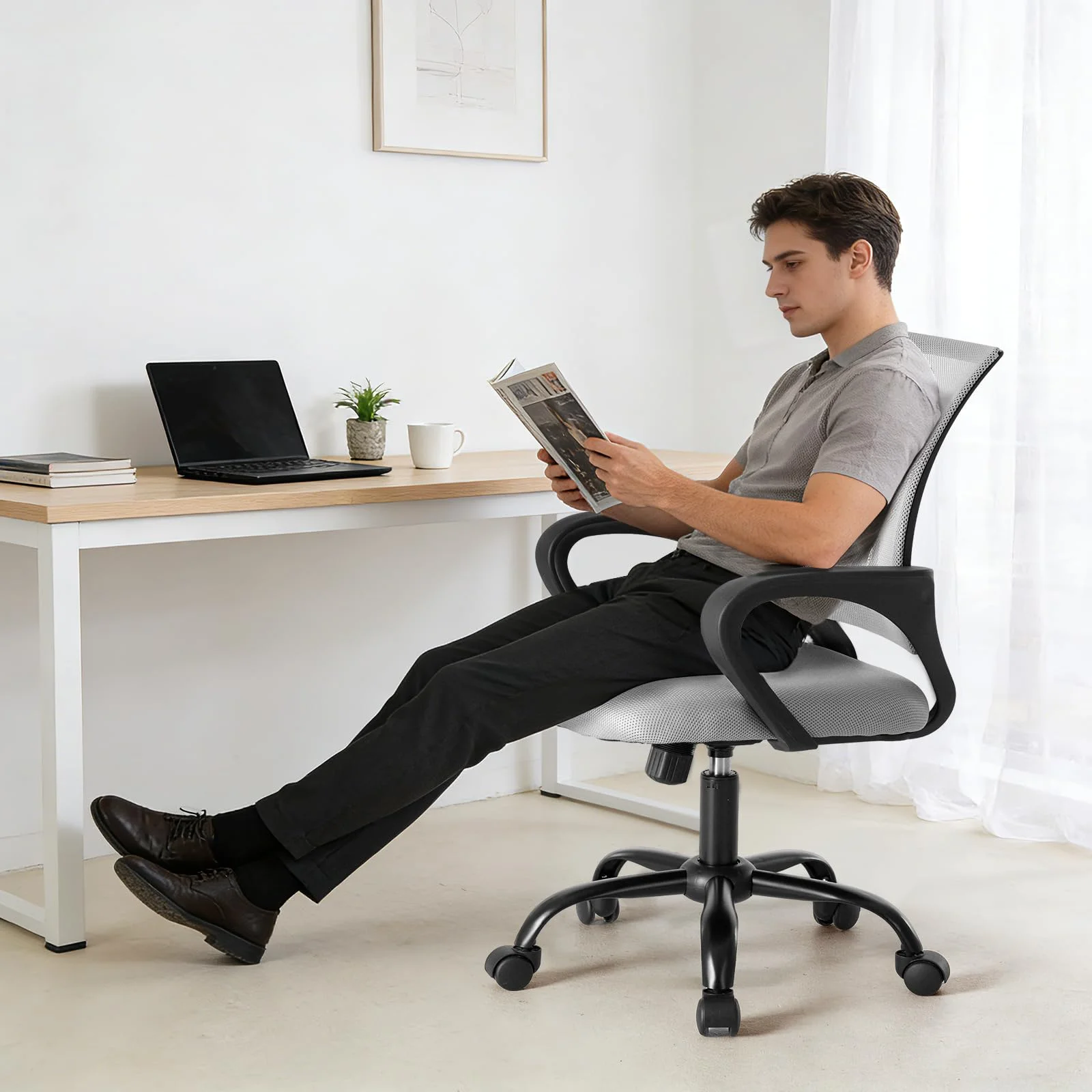
Our ergonomic mesh desk chair, $35.98 in the current update, is the catalog's plainest route to that checklist: adjustable height, a mesh back with real lumbar shape, and armrests where elbows actually land. The mesh matters more than it looks like it should. An office chair is sat in for the length of a workday, and fabric that breathes is the difference between the two-hour sit and the eight-hour sit.
The variations up and down the line answer specific rooms rather than specific egos. The armless small desk chair, $32.95, is the answer where the desk tucks into a corner so tight that armrests would dock under the surface. It slides fully under the desk when the workday ends, which in a bedroom office is the difference between an office corner and a bedroom with a chair problem. The gaming chair at $68.48 buys a high back and a headrest for the long-session sitter. The executive PU leather format at $95.99 buys the wipe-clean surface and the deeper cushion, which video-call rooms tend to appreciate. And for the corner that receives clients rather than producing work, the faux leather guest chair at $92.99 gives a visitor ergonomic seating without an office chair's mechanism under it.
Whatever the chair, set it up against the checklist on day one: seat height until feet sit flat and knees square, lumbar support into the curve of the lower back, screen raised until its top edge sits at eye level. The checklist is linked in the sources below. It is short, public, and better than any adjacent folklore.
The paper problem
Paper was supposed to be dead by now. Instead it accumulates with the patience of sediment: warranties, school forms, tax years, the manual for the dishwasher, the printed thing that must be signed and returned. A home office without a paper plan becomes a paper display.
The plan is one piece of furniture. Our seven-drawer file cabinet on wheels, $69.98 in the current update, is the entire system: hanging files for the categories that recur, deep drawers for the archive layer, a lockable drawer for passports and the documents whose loss costs weeks, and a top surface that doubles as a printer stand. The wheels are not a gimmick. A cabinet that rolls can live inside a closet and commute to the desk, which is how a borrowed corner keeps its floor.
The workflow that makes the cabinet work is a single habit: paper gets one touch. It arrives, it is filed or it is recycled, and nothing earns a temporary pile, because there is no such thing. Every pile is permanent the moment it forms. One cabinet, one habit, and the desk surface belongs to work again.
The wall: memory you can walk past
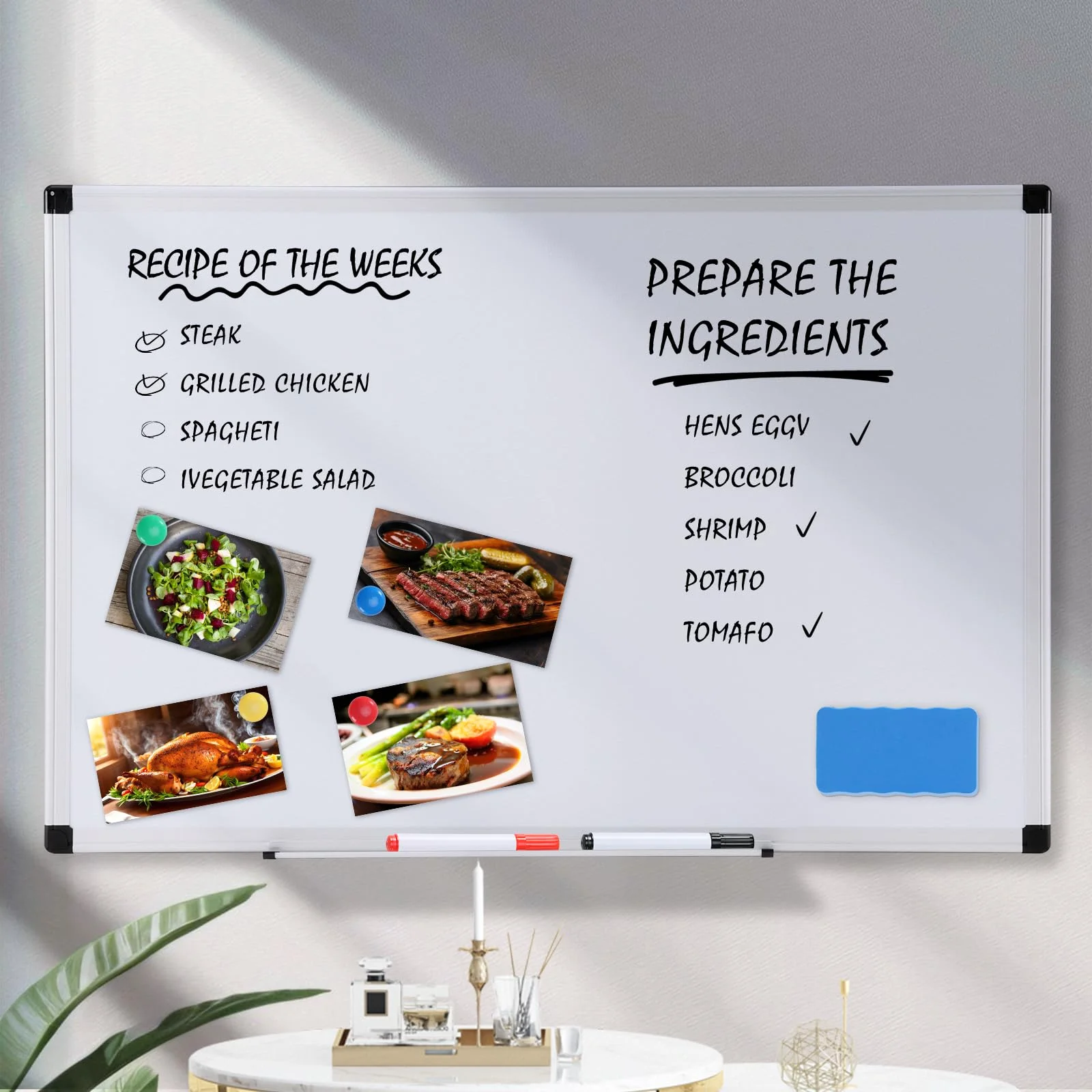
The last piece of the corner is vertical. A magnetic whiteboard, 36 by 24 inches at $26.90 in the current update, does for a household what standups do for a team: it makes the current state visible without anyone asking. The week's shape, the list that must not be forgotten, the number that keeps being needed. Written at eye level, they stop renting space in anyone's head.
The magnetic surface earns the adjective by holding the paper layer too: the invitation, the permission slip, the ticket that must survive until Thursday. Wall, not fridge, because the fridge is where information goes to become invisible.
Movement: the office that does not hold still
Here is the part of the office guide that furniture catalogs usually skip, and the part public health will not let us skip. The CDC's activity guideline for adults is 150 minutes of moderate movement a week, and its most useful clause for desk workers is that the minutes can be broken into small pieces. The guidance explicitly counts spread-out, smaller chunks of activity toward the total.
That clause is an office design instruction. A workday is a long archipelago of small gaps: the call that could be a walk, the file that is rendering, the kettle that is heating. Furniture that turns those gaps into minutes is furniture that pays for itself in something other than money.
Two of our machines are built for exactly this. The under-desk walking pad, $65.99 in the current update, slides beneath the desk it serves and turns the reading-and-calls layer of the workday into slow accumulated steps. The under-desk elliptical, $57.05, answers the rooms and knees for which walking in place is wrong: a seated pedal motion, quiet enough for the call itself, that keeps the joints moving through the sitting hours.
Neither machine is exercise equipment in the gym sense, and that is their point. The gym session that does not happen contributes nothing. The two hundred quiet pedal minutes that do happen contribute all of themselves. For the room where the actual training lives, the weight bench and the rest of the recovery wall, the gym section of the front page picks up where this paragraph stops.
The corner on camera
For a growing share of workers, the office corner has an audience: the video call has made a few square feet of every home semi-public, and the corner deserves five minutes of staging for the role.
The camera's rules are few and cheap. Light from in front or beside, never from behind. A window at your back turns the call into a silhouette interview. The wall behind you is the whole set, so give it one calm thing, a shelf edge, a plain wall, the whiteboard if its contents are shareable, rather than the room's live clutter. And raise the laptop until the camera meets your eyes, which is better for the call and, not incidentally, is the same top-of-screen-at-eye-level position the OSHA checklist wanted anyway. On the L-shaped desk, the second wing holds the stack of books that does this job with dignity.
The chair matters on camera too, in a way nobody mentions: a chair that forces slouching reads as disengagement at the other end of the call. The lumbar setup from the chair section is also, as it turns out, presentation advice.
Sound is the half of the call that furniture actually fixes. Hard rooms echo, and echo reads as distance. The office corner softens itself with exactly the objects already standing in it, because a filled file cabinet, a fabric-drawer desk and a seated body are all absorbers. If the corner still rings, the cheapest treatment in the building is a rug under the chair, which the downstairs neighbors will also vote for. The doors and machines of the household are a scheduling problem rather than an acoustic one, and the shift calendar from the next section handles them better than any panel.
Two workers, one corner
The hardest version of the home office problem is the household with two remote workers and one viable corner, and it has answers short of a lease.
The first is temporal, and it is the cheap one: the corner works shifts. Two people rarely hold their meeting-heavy hours in the same half of the day, and a corner with a calendar taped to the whiteboard becomes two offices separated by time. The file cabinet's drawers split by owner, the desk surface clears completely at handoff, and the chair adjusts in seconds if the two bodies differ, which is precisely why the adjustments exist.
The second answer is spatial, for homes where the shifts collide. The L-shaped desk seats two workers at right angles in a pinch, one per wing, and the armless chair's virtue returns: two of them tuck fully under the wings between sessions, keeping the doubled corner from reading as a call center. It is not a permanent arrangement anyone would choose, but as a bridge through the overlapping hours it beats the alternative, which is the kitchen table, conscripted again.
The third answer is the honest one for households where both careers are permanently remote: build the second corner. The audit from the first section usually found more than one candidate. The runner-up spot, equipped with the small-format pieces, the 31-inch desk class, the armless chair, becomes a second office for less than the cost of one month of coworking. Two small corners in two rooms beat one contested corner in every household that has tried both.
The corner, priced as a project
Assembled from the pieces above, the whole working corner comes in at a number worth seeing in one place.
| The piece | The job | Price |
|---|---|---|
| 47-Inch L-Shaped Corner Desk | The surface, folded into a corner | $41.99 |
| Ergonomic Mesh Desk Chair | The eight-hour sit | $35.98 |
| 7-Drawer File Cabinet on Wheels | The paper system | $69.98 |
| Magnetic Whiteboard, 36x24-Inch | The visible memory | $26.90 |
| Under-Desk Walking Pad | The minutes between | $65.99 |
The full corner, movement included, lands around $240 at current-update prices, and the first four pieces alone, the sit-down office, come in under $175. Prices move between updates. Where a figure here disagrees with its checkout, the checkout is right, and the schedule lives on our update page.
Build order matters less here than in the bedroom, but one sequence saves frustration: desk first, then chair adjusted to the desk, then the cabinet filed in one sitting, then the wall. The walking pad arrives last, once the corner has proven it will be used. Movement furniture in an unused corner is the most eloquent clutter there is.
Keeping the border
The corner is built. The remaining work is jurisdictional, and it is the part no purchase can do for you.
The border that made the corner an office needs defending in both directions. Work stays inside it: the laptop sleeps on the desk, not the couch, and the file cabinet's lock is also a lid on the workday. Home stays outside it: the corner does not become the mail table, the charging depot or the place bags land, because surfaces attract function, and a surface that hosts three functions hosts none well.
The evening ritual that enforces the border takes ten seconds and is worth naming plainly: the chair slides under the desk. That single motion is the door an office corner does not have, and households that adopt it report the same small strange relief, which is the sound of work actually ending.
A working corner built this way outperforms rooms twice its size, because it was designed around the only three things an office truly is: a surface that holds the work, a chair that holds the body, and a border that holds the line. The bedroom that often shares this floor plan has its own full guide, the kitchen's version of this argument is the counter space budget, and the whole house, room by room, is on the front page.
